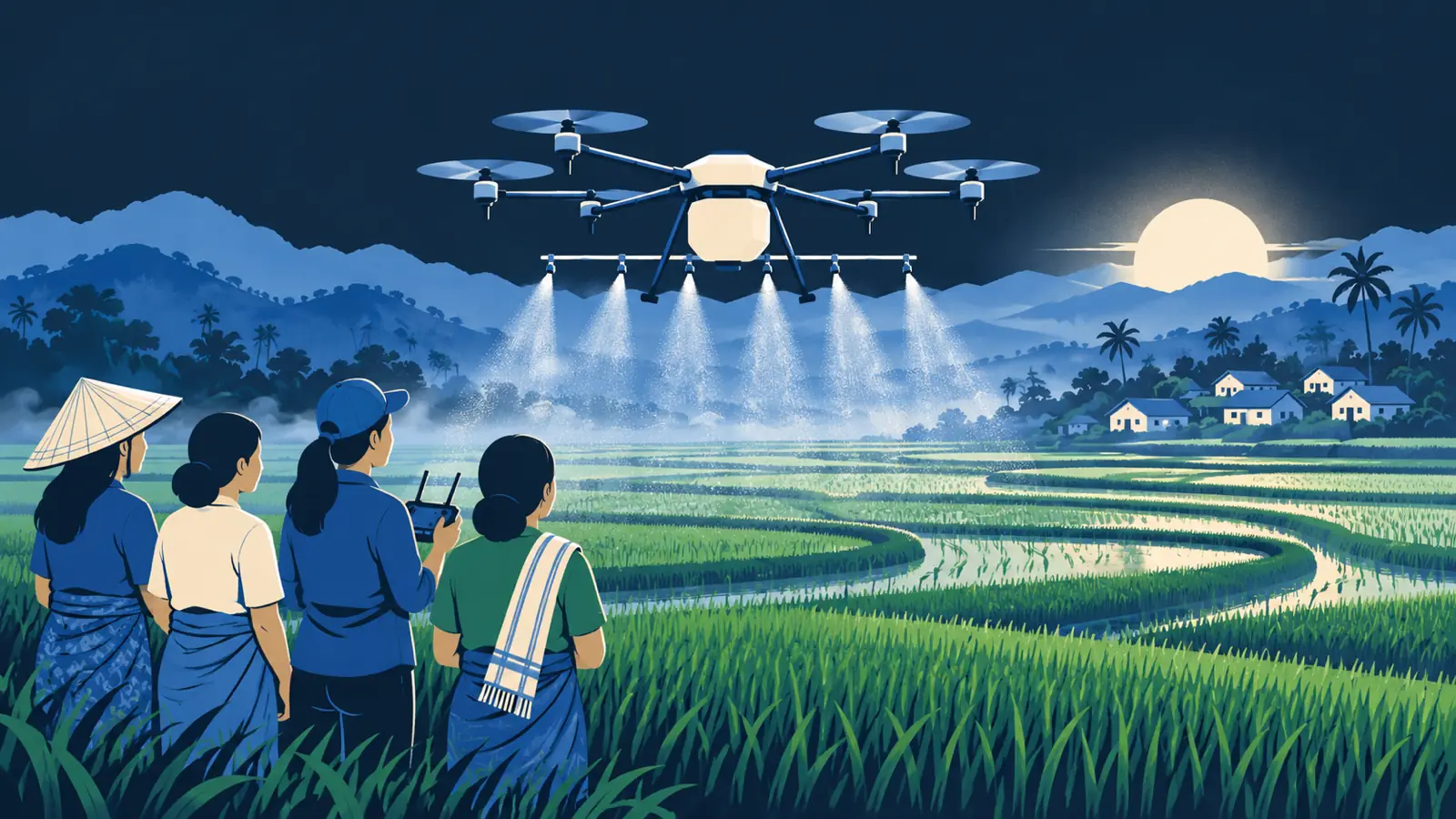

Late September is a nervous time in many paddy fields. The crop is heading towards flowering, the air is humid after the monsoon, and that's exactly the weather rice blast likes. On 23 September 2025, the agromet advisory for Palakkad in Kerala reported that blast had already been found in some nurseries in the district and told farmers to take precautions. Advisories like that come out every season, in state after state, which says a lot about how stubborn this disease is.
A very old problem with a very large bill
Rice blast is caused by the fungus Magnaporthe oryzae. It attacks leaves, stem nodes, the neck of the panicle and the grain itself, and it's found wherever rice is grown.
The losses are hard to pin down exactly, but the estimates are large. A review in Trends in Biotechnology put the loss at between 10% and 30% of the annual rice harvest. Another widely cited estimate says the rice lost to blast each year would be enough to feed about 60 million people. With rice as the staple food for more than three billion people, even the low end of that range matters.
Why it's so hard to control
A few things make blast unusually difficult.
The fungus spreads through spores carried by wind and water, so one infected patch can seed a whole area within days when the weather is right. Long spells of leaf wetness, high humidity and moderate night temperatures favour it, which is why risk climbs after rain and on cloudy, damp days.
It also adapts. Resistant varieties help, but the fungus can overcome resistance genes over time, so breeders are in a long race with it.
And timing is everything. Neck blast, which hits the panicle, can do the most damage to yield, and once it's visible the window to protect the crop is short. That's why advisories focus on watching the field closely and acting early instead of waiting for obvious symptoms.
OUR LABWe build our own autonomous drone.Explore the product →
How growers find it today
For most farmers, detection still means walking the field and looking at the leaves. Spotting the first diamond-shaped lesions on a few plants in a large field takes time and a trained eye, and it's easy to miss the early stage.
Around that, there are two kinds of help. Weather-based advisories, like the Kerala bulletin above, warn when conditions favour the disease. Extension officers and agricultural universities then advise on what to do locally, including which treatments are approved. Anyone dealing with an outbreak should follow that local advice.
Where technology is heading
Researchers around the world are working on ways to spot blast earlier and over larger areas than a person can cover on foot.
Drone imaging is one of the most active directions. A study published in Plant Methods in February 2025 used images from a small commercial drone flown at about five metres to map panicle blast and grade its severity, reporting an overall accuracy of 91.4% on its test set. Earlier work tackled a different hurdle, the shortage of labelled images of early infections, with semi-supervised models trained on drone photos.
Results like these come from controlled trials, and the authors themselves point out the weak spots, such as lower accuracy on the most severe classes where there were few examples. Moving from a research plot to thousands of real fields, with different varieties, light and camera heights, is the hard part.
The likely future is a mix: weather models to say when risk is high, imaging from drones or phones to show where it's starting, and local experts to decide what to do about it.
Why we follow this
At Ryo Forge, our lab works on autonomous agricultural systems, edge AI and computer vision, so crop health and early detection are topics we keep a close eye on. It's also the kind of engineering we bring to client work: real data, messy conditions and software that has to work in the field. Visit the lab.
Sources
- Kerala Agricultural University, RARS Pattambi. Agromet advisory bulletin, Palakkad, 23 September 2025.
- Skamnioti, P. and Gurr, S. (2009). Against the grain: safeguarding rice from rice blast disease. Trends in Biotechnology 27(3).
- Wang, X. et al. (2014). Current advances on genetic resistance to rice blast disease. In Rice: Germplasm, Genetics and Improvement, IntechOpen.
- Plant Methods (February 2025). UAV rice panicle blast detection based on enhanced feature representation and optimized attention mechanism.
- Plants (2023). Early detection of rice blast using a semi-supervised contrastive unpaired translation iterative network based on UAV images.