Spring is when farmers line up their spraying for the season, and in 2026 a lot of them, especially in the US, are doing it with more uncertainty than usual. In the space of a few months, the rules around which drones can be sold, how far they can fly on their own, and how much they can see have all shifted.
The US decision on foreign-made drones
On 22 December 2025, the US Federal Communications Commission added foreign-made drones and their critical components to its Covered List. In practice, new foreign-made models can't get the FCC authorisation they need to be sold, unless the Department of Homeland Security or Department of Defense approves them. Drones farmers already own can keep flying.
For agriculture, this is a big deal because one company dominates the category. A Michigan State University study cited in industry coverage put DJI's share at roughly 80% of US agricultural spray drone sales. Farm groups have warned about what happens when existing fleets age and spare parts and newer models can't come in.
DJI has challenged the decision. In February 2026 it filed an appeal in the US Court of Appeals for the Ninth Circuit, calling the decision flawed, while the FCC says it followed a thorough security review. Until that's resolved, US operators are planning with the drones and parts they can get.
The wider effect is an opening for other manufacturers, in the US and elsewhere, to compete on price, reliability and software. That will take time.
Flying further on their own: BVLOS
The second change is about autonomy. Most commercial drone flights in the US have to stay within the pilot's sight unless the operator gets a waiver. On 7 August 2025, the FAA proposed a new rule, Part 108, to make routine beyond-visual-line-of-sight (BVLOS) operations possible without case-by-case waivers, and it names precision agriculture among the uses it has in mind. The comment period closed on 6 October 2025 with more than 3,000 comments.
The final rule hadn't been published when we wrote this. Until it is, agricultural spraying in the US still runs on the existing framework, which for heavier spray drones means several layers of approval, including an agricultural aircraft operator certificate and a state pesticide applicator licence.
Other countries are moving at their own pace. India, for example, has focused on subsidies and certified models to get drones onto farms, which we covered in our look at India's agricultural drone schemes.
OUR LABWe build our own autonomous drone.Explore the product →
Seeing the crop before spraying it
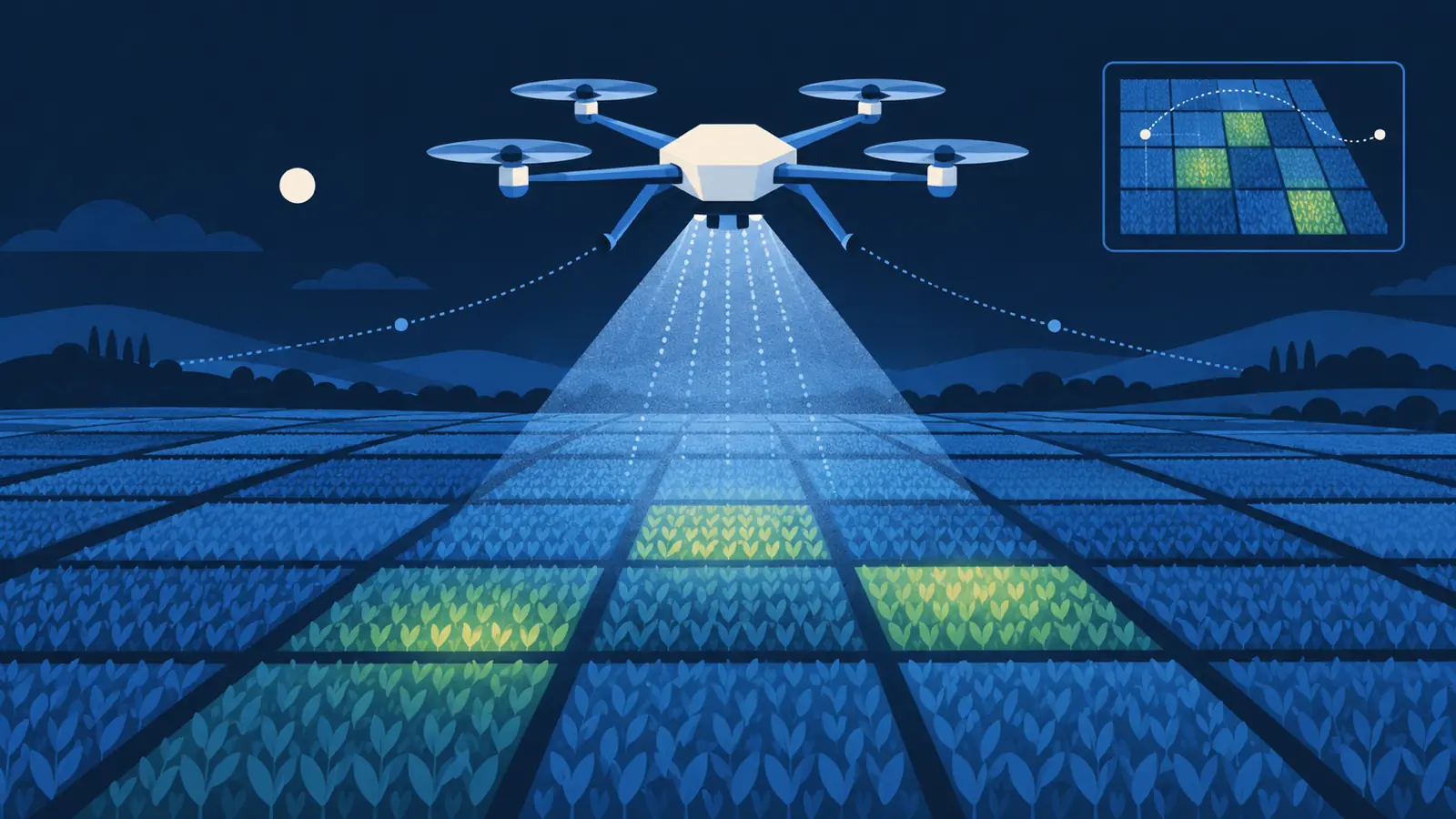
The third shift is in research. The focus is moving from drones that spray a whole field evenly to drones that can see where the problem is.
A team in Thailand, writing in PLOS ONE in January 2025, mapped rice bacterial leaf blight from multispectral drone images and reported a mean IoU of up to 97.2% when it added a vegetation index (NDVI) to the camera bands. A study on rice blast the following month reached 91.4% overall accuracy on its test set using ordinary RGB images from a small drone. Both come from the authors' own fields and datasets. The real-world problem is getting a model like that to hold up across other fields, varieties, seasons and light conditions, and that's much harder than a strong score in one trial.
That's the gap the industry is working on: models small enough to run on the drone itself, reliable enough to trust outside a test plot, and connected to a sprayer that can act on what they see.
What it adds up to
For growers, 2026 is a year to plan around supply and spare parts, and to keep an eye on the BVLOS rules. For builders, the opportunity has shifted. Hardware alone is crowded and politically complicated. Autonomy, perception and the software that turns an image into a decision are where the open problems are.
Why we follow this
At Ryo Forge, our lab works on autonomous agricultural systems, edge AI and computer vision, so these shifts in rules and research shape how we think about the field. See what we work on in the lab.
Sources
- DroneXL (13 January 2026). FCC drone ban threatens agricultural operations, warns Texas Farm Bureau.
- KCRG (25 February 2026). Chinese drone company sues FCC over covered list decision.
- DLA Piper (13 October 2025). FAA proposed Part 108 BVLOS rule.
- Rupprecht Law. Drone sprayers: laws and requirements.
- PLOS ONE (January 2025). Field-scale detection of Bacterial Leaf Blight in rice based on UAV multispectral imaging and deep learning frameworks.
- Plant Methods (February 2025). UAV rice panicle blast detection based on enhanced feature representation and optimized attention mechanism.