
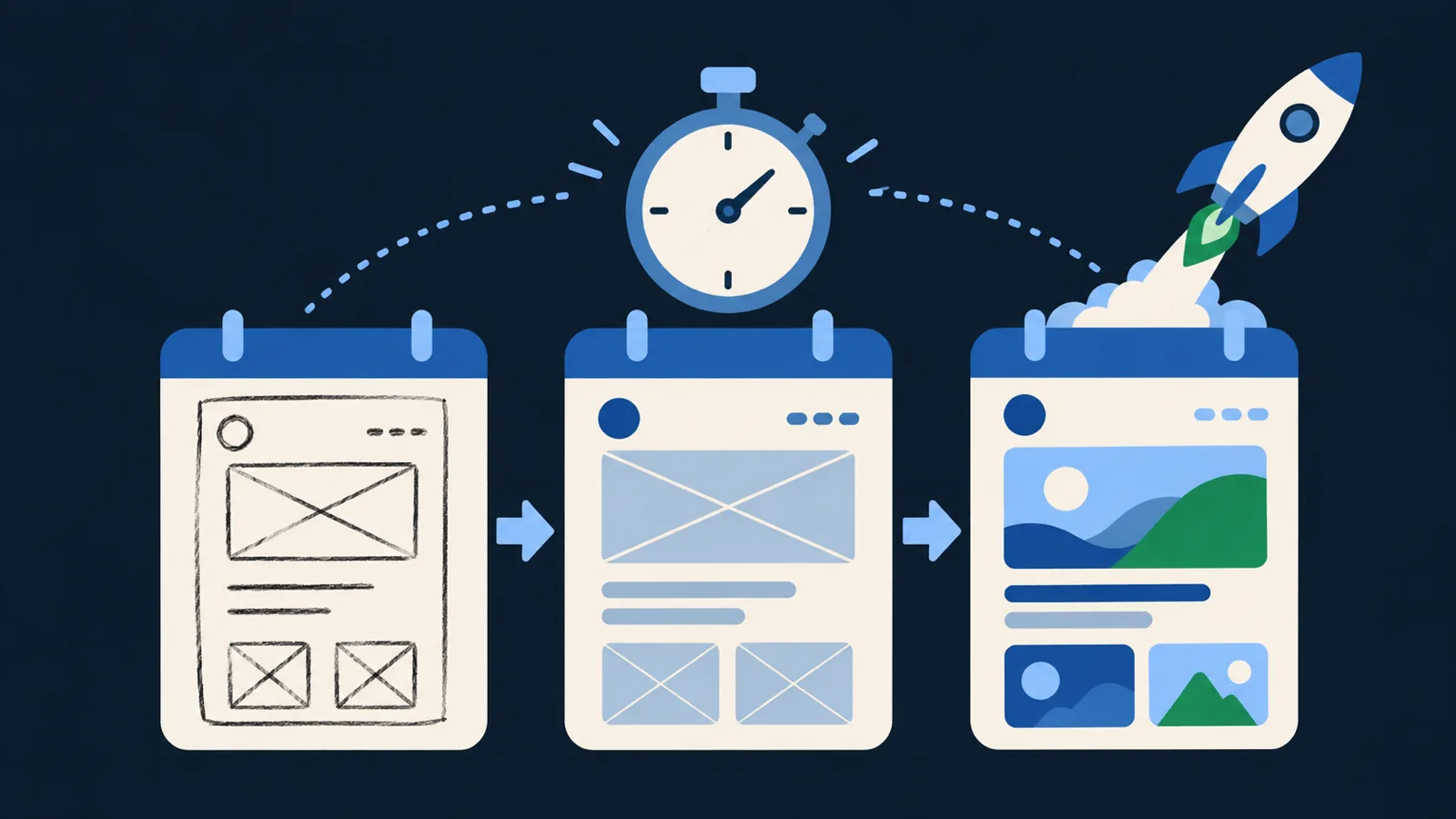
With a traditional agency, a typical MVP takes 2 to 4 months. A focused MVP with 3 to 5 core features can be live in 2 to 3 weeks if a small senior team builds it on proven building blocks.
Typing speed has little to do with that gap. Most of it comes from how tightly the scope is set, how quickly decisions get made, and how the work is run.
A realistic 3-week MVP plan
Days 1–2: scope
We run a workshop on who the users are and what the MVP has to prove. The feature list gets cut to the 3 to 5 that matter, and the result is written down with a fixed price.
Week 1: design and foundations
The core screens get designed. The architecture is set, login and the database are built, and a staging link goes live, so by Friday you can click through something real.
Week 2: core features
The team builds the workflows your users need and demos them at the end of the week. You test them and give feedback, and the team adjusts.
Week 3: polish and launch
This week covers testing, analytics, deployment to your own cloud account and a handover session. By the end, the MVP is live and real users can sign up.
What makes an MVP take months instead of weeks
- Scope creep is the usual cause. "While we're at it" sounds harmless, but every added feature brings its own design, build and testing.
- Slow decisions hold everything up. If a question waits a week for an answer, so does the project. A weekly demo and a short daily written update keep decisions moving.
- Teams rebuild things that already exist. Login, payments and admin panels are solved problems, so reuse them.
- Large teams spend more of their time coordinating. A small senior team usually moves faster than a big junior one.
- Perfectionism delays launch. An MVP is there to learn from real users, and polish can wait for version 2, once you know what they value.

Timelines by type of MVP
| Type of MVP | Focused timeline |
|---|---|
| Clickable prototype (not real software) | 1–2 weeks |
| Web app MVP | 2–3 weeks |
| SaaS MVP with subscriptions | 3–4 weeks |
| Mobile MVP (iOS + Android) | 3–5 weeks |
| AI MVP on your data | 3–4 weeks |
| Full launch-ready product | 6–8 weeks |
How to keep your MVP fast
- Write down the one thing the MVP must prove.
- Choose the 3 to 5 features that prove it and park everything else.
- Make one person on your side the decision-maker.
- Ask for a weekly demo on a live link instead of status reports.
- Agree a fixed price and a fixed date before work starts.
How we do it
At Ryo Forge, MVPs ship in 2 to 3 weeks and full products in 6 to 8, at a fixed price. You see a demo every week, and the code is yours. See how our MVP development works or book a free scoping call.